Melanoma: Diagnosis, Wide Local Excision and Sentinel Lymph-Node Biopsy
Melanoma & Surgical Treatment (Wide Local Excision and Sentinel Lymph-Node Biopsy)
Melanoma: Diagnosis, Wide Local Excision and Sentinel Lymph-Node Biopsy
Dr-Alassaf
Nov 07, 2026
Melanoma is a skin cancer arising from pigment-producing melanocytes. Early diagnosis is critical because treatment and prognosis are strongly influenced by how deeply the melanoma has invaded the skin. Surgery begins with an accurate diagnostic biopsy and then, when melanoma is confirmed, a wider definitive excision.
What changes in a mole are concerning?
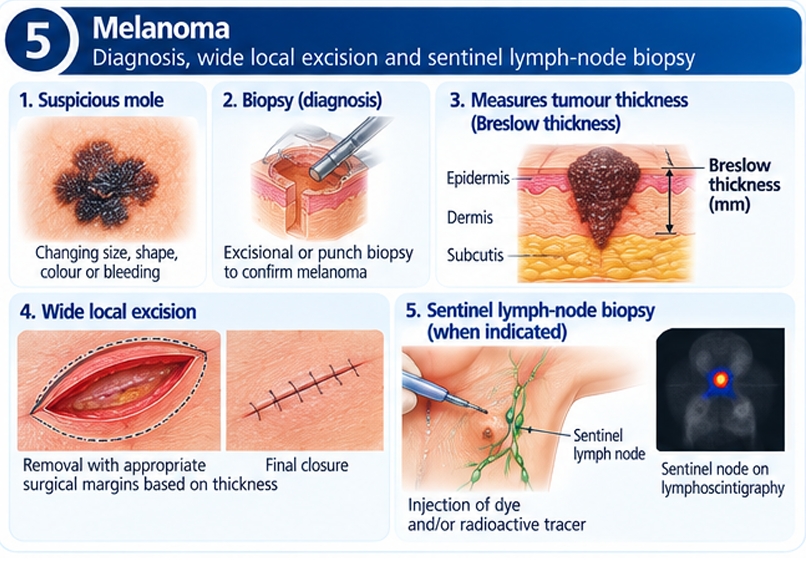
Warning features include asymmetry, irregular borders, multiple or changing colours, enlargement and evolution over time. A new or changing pigmented lesion, bleeding lesion or an 'ugly duckling' that looks different from a patient's other moles deserves assessment.
How should a suspected melanoma be biopsied?
When feasible, the preferred diagnostic approach is complete excisional biopsy with a narrow clinical margin so the pathologist can accurately measure tumour thickness. Partial biopsy is used when complete initial excision is impractical.
What is Breslow thickness?
Breslow thickness measures the vertical depth of invasive melanoma in millimetres. It is one of the most important features determining the required wide-excision margin, whether sentinel-node biopsy should be discussed and the overall stage.
What is wide local excision?
After diagnosis, the biopsy scar and surrounding normal skin are removed with a margin determined mainly by melanoma thickness. This treats microscopic local extension beyond the original lesion.
Why are melanoma margins different from ordinary skin cancer margins?
Melanoma has specific evidence-based margins related to stage and Breslow thickness. Very wide historical margins are no longer routinely used because they do not improve outcome enough to justify unnecessary tissue loss.
What is sentinel lymph-node biopsy?
The sentinel node is the first lymph node or group of nodes draining the melanoma site. A tracer identifies these nodes, which are removed through a separate small incision and examined microscopically for melanoma cells.
Does everyone need sentinel-node biopsy?
No. It is considered according to melanoma thickness, ulceration and other risk features. It provides staging and prognostic information for patients whose risk of microscopic nodal spread is meaningful.
What if the sentinel node contains melanoma?
The result changes the pathological stage and can influence imaging, surveillance and consideration of systemic adjuvant therapy. Routine completion removal of all remaining nodes is no longer automatic for every positive sentinel node.
Will I need a skin graft?
Many wide-excision wounds close directly. Larger margins or difficult anatomical sites may require a flap or graft.
What happens after surgery?
Pathology confirms margin clearance and, when performed, sentinel-node status. Follow-up is based on final stage and includes skin and lymph-node surveillance; higher-risk disease may involve oncology review and additional treatment.
Frequently Asked Questions
Does a melanoma biopsy spread the cancer?
No. Proper diagnostic biopsy does not cause melanoma to spread.
Is melanoma always dark?
No. Some melanomas contain little pigment and can appear pink or red.
Does a negative sentinel node guarantee melanoma will never return?
No, but it is reassuring staging information and is associated with a lower risk than a positive node.
The key message
Melanoma surgery is a staged process: accurate biopsy first, then wide local excision based on Breslow thickness, with sentinel lymph-node biopsy for selected patients when nodal staging is clinically useful.
This article is for general patient education and does not replace individual examination, pathology review or advice from your treating surgeon or dermatologist.
Dr. Mohammed Alassaf
Consultant Bariatric & Gastrointestinal Surgeon
Dr. Alassaf is a leading expert in minimally invasive and bariatric surgery,
with extensive experience helping patients overcome obesity and related conditions.
Having completed advanced training in Australia and the Middle East, he is known
for his compassionate approach and evidence-based surgical care.