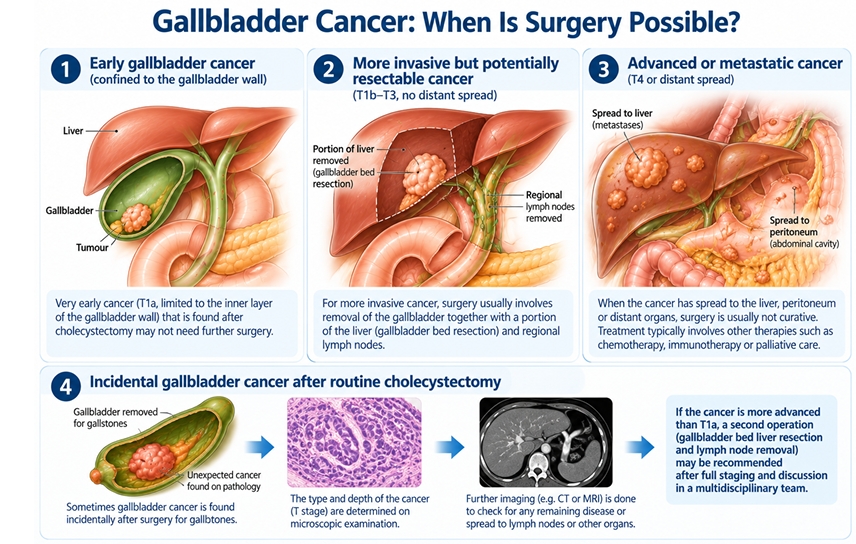
Gallbladder cancer is uncommon and is sometimes discovered unexpectedly after a gallbladder has been removed for presumed gallstones or inflammation. When the disease is localised and can be removed completely, surgery offers the main possibility of long-term disease control or cure. The operation required depends strongly on how deeply the cancer has grown and whether it has spread.
How is gallbladder cancer discovered?
Some cancers are suspected before surgery because imaging shows a mass, irregular wall thickening or invasion into nearby structures. Others are found incidentally by the pathologist after an apparently routine cholecystectomy.
This distinction matters because a gallbladder that is already suspected to contain cancer should be approached as an oncological operation rather than as routine gallstone surgery.
What determines whether surgery is possible?
The key questions are whether the tumour can be removed completely, whether regional lymph nodes are involved, whether major blood vessels or neighbouring organs are invaded, and whether there is disease elsewhere in the abdomen or at distant sites. High-quality cross-sectional imaging - usually CT and often MRI - is therefore central to staging before a major cancer operation.
Selected patients may also undergo staging laparoscopy before committing to a large resection, particularly when there is concern about small-volume peritoneal or liver disease that may not be obvious on scans.
What if the cancer is found unexpectedly after gallbladder surgery?
The pathology report becomes extremely important. It tells us the depth of invasion (T stage), the type and grade of the tumour, whether the cystic-duct margin is involved and other features that influence the need for further treatment.
For a T1a cancer confined to the lamina propria, simple cholecystectomy is generally considered adequate treatment when the gallbladder has been removed intact and margins are clear. T1b disease extends into the muscular layer. The optimal extent of additional surgery for T1b has historically been debated, but many hepatobiliary teams consider completion oncological resection in a suitable patient after staging.
For T2 and selected T3 cancers without distant spread, additional radical resection is commonly considered because residual disease in the liver bed or regional lymph nodes is substantially more likely.
What does a radical gallbladder cancer operation involve?
The objective is an R0 resection - removing all visible and microscopic tumour with clear margins. This usually means removal of the gallbladder, a portion of adjacent liver around the gallbladder bed and a regional lymph-node dissection. Depending on the tumour, the liver component may be a limited gallbladder-bed resection or an anatomical resection involving segments IVb and V.
The extrahepatic bile duct is not automatically removed in every gallbladder cancer operation. It is resected when required to obtain a clear margin or when directly involved. More extensive organ or vascular resection is reserved for carefully selected patients when a complete oncological resection remains realistic.
Why are the lymph nodes important?
Regional lymph nodes provide essential staging information and can contain microscopic disease even when they do not appear enlarged on imaging. Their removal is therefore both an oncological and staging component of radical surgery.
What if the cancer has already spread?
When there is distant metastatic disease or disease that cannot be completely removed, major radical surgery is generally not beneficial as a curative operation. Treatment then focuses on systemic therapy and, when necessary, procedures to relieve problems such as biliary obstruction, pain or infection. Modern systemic treatment may include chemotherapy, immunotherapy and molecularly targeted treatment in selected tumours.
Will I need chemotherapy after surgery?
Many patients with resected gallbladder cancer are considered for postoperative systemic treatment. The recommendation depends on the pathological stage, margins, lymph nodes, fitness and multidisciplinary review. Surgery should therefore be viewed as one component of a broader cancer-treatment plan rather than an isolated event.
What about an intraoperative cholangiogram?
Routine intraoperative cholangiography is part of my standard laparoscopic cholecystectomy technique for benign gallbladder disease. When gallbladder cancer is known or strongly suspected, however, the operation is planned primarily according to oncological principles. The exact biliary imaging and surgical strategy are therefore tailored to the tumour rather than automatically following the routine benign-gallbladder pathway.
Frequently Asked Questions
If cancer is found after a routine cholecystectomy, does that mean the operation was inadequate?
Not necessarily. Very early T1a cancer may be adequately treated by the cholecystectomy already performed. More invasive stages may require staging and a second, more extensive oncological operation.
Does gallbladder cancer always require part of the liver to be removed?
No. Very early T1a disease usually does not. For T2 and selected more invasive resectable cancers, removing adjacent liver tissue is commonly part of the oncological operation.
Do you always remove the bile duct?
No. Bile-duct resection is selective and is generally performed when necessary for tumour clearance or because the duct is directly involved.
Can surgery still help if lymph nodes are involved?
Regional nodal disease worsens prognosis, but selected patients with locoregional disease may still be considered for radical resection. The decision requires careful staging and multidisciplinary discussion.
The key message
Gallbladder cancer surgery is determined by stage, not simply by the presence of a tumour. T1a cancer found incidentally may require no further surgery, while T2 and selected T1b/T3 cancers can require a second oncological operation involving the liver bed and regional lymph nodes. The aim is complete tumour removal with clear margins in a carefully staged patient.
This article is for general patient education and does not replace individual assessment, cancer staging or advice from a specialist hepatobiliary multidisciplinary team.
Dr. Mohammed Alassaf
Consultant Bariatric & Gastrointestinal Surgeon
Dr. Alassaf is a leading expert in minimally invasive and bariatric surgery,
with extensive experience helping patients overcome obesity and related conditions.
Having completed advanced training in Australia and the Middle East, he is known
for his compassionate approach and evidence-based surgical care.