Surgery can be one of the most effective treatments for selected liver tumours, but the decision is more complex than simply asking whether a mass can be cut out. The tumour type, liver function and the amount of healthy liver that will remain are central to planning.
Are all liver tumours treated the same way?
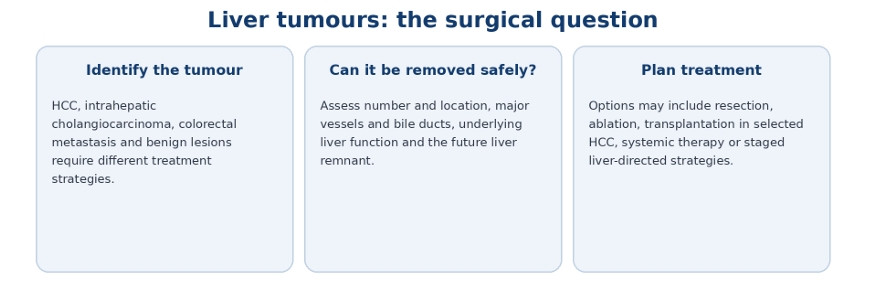
No. A primary liver cancer such as hepatocellular carcinoma (HCC) is biologically different from intrahepatic cholangiocarcinoma or a metastasis that has spread to the liver from another organ. Benign tumours form another group. The diagnosis must therefore be established before deciding whether surgery is useful.
What makes a liver tumour resectable?
The goal is to remove all tumour while leaving enough healthy, functioning liver with adequate blood inflow, venous outflow and bile drainage. Tumour size alone does not determine resectability. Number, distribution and relationship to major vessels can be more important.
Why does the quality of the remaining liver matter?
Unlike many organs, the liver can regenerate after part of it is removed. However, regeneration requires an adequate future liver remnant. Cirrhosis, portal hypertension, chemotherapy-related liver injury, fatty liver and other liver disease can reduce the amount of liver that can safely be removed.
What about hepatocellular carcinoma?
For selected patients with localised HCC and adequate liver reserve, partial hepatectomy can offer long-term disease control. Liver transplantation is another potentially curative option for selected patients, particularly when underlying cirrhosis makes resection less suitable.
Can minimally invasive liver surgery be used?
Yes, selected liver resections can be performed laparoscopically or robotically. The approach depends on tumour position, extent of resection, vascular anatomy and surgeon expertise. The oncological operation should not be compromised simply to use smaller incisions.
What if the tumour cannot initially be removed?
Some patients may become candidates for surgery after systemic therapy or liver-directed treatment. Portal-vein embolisation can sometimes enlarge the future liver remnant before a planned major hepatectomy. Ablation may be combined with resection in selected situations.
Will the liver grow back?
The remaining liver commonly increases in volume after resection, but this is not the same as recreating the removed anatomical segments. Safe surgery therefore depends on leaving enough functioning liver from the start.
Frequently Asked Questions
Does a large liver tumour automatically mean it is inoperable?
No. Size matters, but distribution, vascular involvement, liver function and the amount of liver that can safely remain are critical.
Do all liver tumours need biopsy?
No. In some clinical settings imaging can establish the diagnosis sufficiently for treatment planning; in others biopsy is important. The decision is disease-specific.
Can liver tumours return after surgery?
Yes. Recurrence risk depends on tumour biology and stage, so surgery is often one part of a broader treatment and surveillance plan.
The key message
Successful liver surgery means removing the tumour while preserving enough healthy, functioning liver. Tumour biology and liver quality are as important as tumour size.
This article is for general patient education and does not replace individual assessment, specialist multidisciplinary review or advice from your treating team.
Dr. Mohammed Alassaf
Consultant Bariatric & Gastrointestinal Surgeon
Dr. Alassaf is a leading expert in minimally invasive and bariatric surgery,
with extensive experience helping patients overcome obesity and related conditions.
Having completed advanced training in Australia and the Middle East, he is known
for his compassionate approach and evidence-based surgical care.