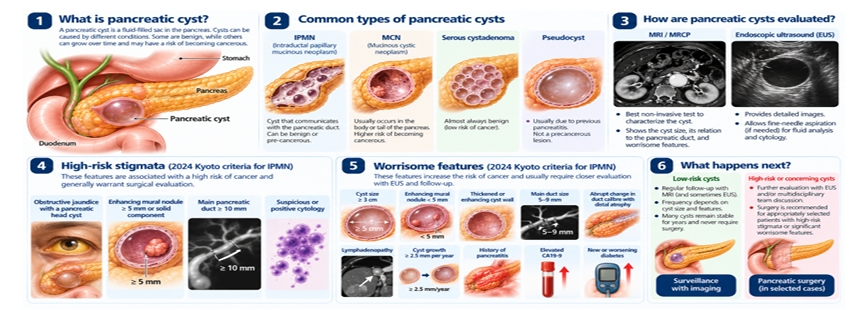
Pancreatic cysts are increasingly discovered by chance on CT or MRI. Most do not require an operation. The important task is to identify what type of cyst is present and whether it carries features suggesting a meaningful risk of high-grade dysplasia or cancer.
Are all pancreatic cysts the same?
No. Pancreatic cysts include IPMN, mucinous cystic neoplasm (MCN), serous cystadenoma, pseudocysts and other less common lesions. Their cancer risk is very different, so identifying the likely cyst type is the first step.
How are pancreatic cysts investigated?
MRI with MRCP is particularly useful for showing cyst size, internal features and communication with the pancreatic duct. CT can provide complementary information. Endoscopic ultrasound (EUS) gives detailed images and, when appropriate, permits fine-needle aspiration for fluid analysis and cytology.
Which findings are considered high risk?
For IPMN, the 2024 Kyoto guidelines define high-risk stigmata as obstructive jaundice caused by a cystic lesion in the pancreatic head, an enhancing mural nodule 5 mm or larger or a solid component, a main pancreatic duct 10 mm or larger, and suspicious or positive cytology when obtained. These findings usually prompt serious consideration of surgery in a suitable patient.
What are 'worrisome features'?
Kyoto worrisome features include acute pancreatitis, raised CA19-9, new or recently worsening diabetes, cyst size 30 mm or larger, an enhancing mural nodule under 5 mm, thickened or enhancing cyst walls, main pancreatic duct 5-9 mm, abrupt duct-calibre change with distal pancreatic atrophy, lymphadenopathy and growth of at least 2.5 mm per year.
Does a 3 cm cyst automatically need surgery?
No. Size of 3 cm or more is a worrisome feature for IPMN, not by itself an automatic indication for pancreatic resection. The complete pattern of imaging, duct changes, nodules, symptoms, cytology, age, fitness and life expectancy matters.
What surgery is performed if a cyst needs removal?
The operation depends on location. Lesions in the pancreatic head may require pancreaticoduodenectomy (Whipple), while body or tail lesions may require distal pancreatectomy. Because pancreatic surgery carries meaningful risks, the predicted cancer risk must justify the operation.
What if the cyst looks low risk?
Many pancreatic cysts are best managed with surveillance rather than surgery. The interval and duration of follow-up depend on cyst type, size, changes over time, patient age and fitness. Surveillance is intended to identify meaningful change while avoiding unnecessary pancreatic operations.
Frequently Asked Questions
Can a pancreatic cyst disappear?
Some inflammatory collections such as pseudocysts can resolve, but true cystic neoplasms behave differently and require diagnosis-specific management.
Does every cyst need EUS?
No. EUS is most useful when MRI/CT leaves uncertainty or when concerning features could change management.
Can a pancreatic cyst become cancer?
Some mucinous cysts, particularly IPMN and MCN, have malignant potential, but the risk varies greatly between lesions.
The key message
Most pancreatic cysts do not need surgery. The decision is a balance between the cyst's estimated cancer risk and the very real consequences of pancreatic resection.
This article is for general patient education and does not replace individual assessment, specialist multidisciplinary review or advice from your treating team.
Dr. Mohammed Alassaf
Consultant Bariatric & Gastrointestinal Surgeon
Dr. Alassaf is a leading expert in minimally invasive and bariatric surgery,
with extensive experience helping patients overcome obesity and related conditions.
Having completed advanced training in Australia and the Middle East, he is known
for his compassionate approach and evidence-based surgical care.