If thyroid surgery has been recommended, one of the most important questions is whether to remove one thyroid lobe
or the entire gland. The answer is not simply that a larger operation is safer. Modern thyroid surgery aims to perform the
amount of surgery needed for the disease while avoiding unnecessary risk and preserving thyroid function whenever
appropriate.
What is a thyroid lobectomy?
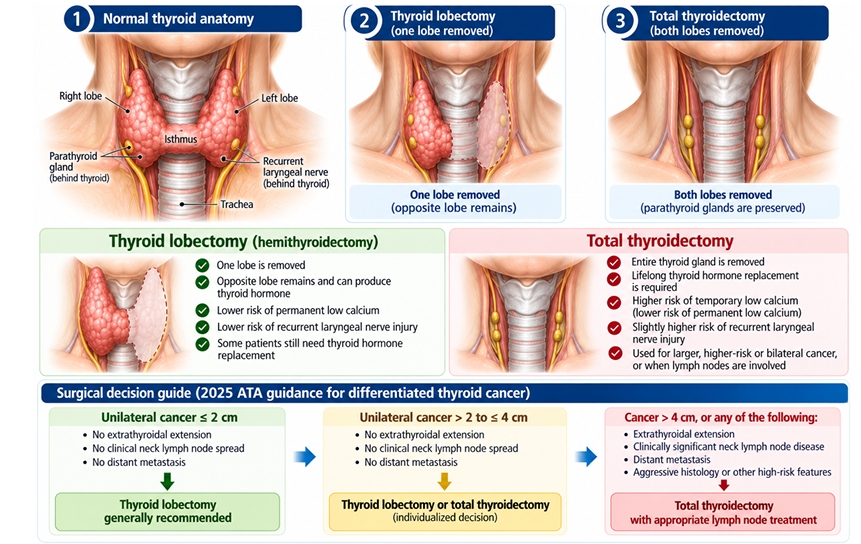
A thyroid lobectomy, or hemithyroidectomy, removes one thyroid lobe, usually together with the isthmus. The opposite
lobe remains in place. Lobectomy is used for many benign unilateral nodules, selected indeterminate nodules, toxic
nodules and increasingly for appropriately selected low-risk differentiated thyroid cancers.
What is a total thyroidectomy?
A total thyroidectomy removes essentially the entire thyroid gland. It is appropriate for disease involving both lobes and
for many larger, invasive, nodal or otherwise higher-risk thyroid cancers. It is also used for selected non-cancerous
conditions affecting the whole gland.
Why does preserving one thyroid lobe matter?
The remaining lobe may continue producing enough thyroid hormone for normal function. This means some patients
can avoid lifelong levothyroxine. Lobectomy also avoids operating around the recurrent laryngeal nerve and parathyroid
glands on the opposite side of the neck.
How do the operations differ technically?
Both operations are usually performed through a low neck incision. During lobectomy, the surgeon mobilises one
thyroid lobe, carefully identifies and protects the recurrent laryngeal nerve and preserves the parathyroid glands and
their blood supply on that side. Total thyroidectomy repeats this dissection on the opposite side, exposing both
recurrent laryngeal nerves and all parathyroid glands to operative manipulation.
Which operation has the lower complication risk?
Because lobectomy is limited to one side, it generally carries a lower overall risk of complications than total
thyroidectomy. In particular, permanent hypoparathyroidism is essentially a complication of bilateral thyroid surgery
rather than routine unilateral lobectomy. The risk to the recurrent laryngeal nerve also increases when both sides are
dissected.
What is the recurrent laryngeal nerve?
The recurrent laryngeal nerve runs immediately behind the thyroid and controls movement of the vocal cord. Injury can
cause hoarseness, a weak voice or swallowing symptoms. Injury to one nerve is usually compatible with breathing;
injury to both nerves during bilateral surgery can be much more serious, which is one reason meticulous nerve
identification is essential.
What are the parathyroid glands?
Most people have four small parathyroid glands behind the thyroid. They regulate blood calcium. During thyroid surgery
they should be preserved with their blood supply. Temporary low calcium is relatively common after total thyroidectomy,
while permanent hypoparathyroidism is much less common but important because it can require long-term calcium and
active vitamin D treatment.
Will I need thyroid-hormone tablets after lobectomy?
Not necessarily. Many patients maintain normal thyroid function with one lobe. Others develop hypothyroidism and
require levothyroxine. The chance is higher when thyroid function was already borderline, thyroid antibodies are
present, or the remaining lobe has underlying disease. Thyroid function is checked after surgery.
Will I need thyroid hormone after total thyroidectomy?
Yes. Once the entire thyroid has been removed, lifelong levothyroxine replacement is necessary. The dose is adjusted
using thyroid blood tests. In some thyroid-cancer patients, the target TSH level is also influenced by recurrence risk.
How does cancer size affect the choice?
The 2025 ATA differentiated thyroid cancer guideline recommends lobectomy for cancer limited to one lobe measuring
2 cm or less when there is no extrathyroidal extension or clinical neck lymph-node spread. For unilateral cancers larger
than 2 cm and up to 4 cm with similarly favourable features, lobectomy or total thyroidectomy can be appropriate after
individualised discussion.
When is total thyroidectomy favoured for cancer?
Total thyroidectomy is generally recommended for differentiated thyroid cancers larger than 4 cm, cancers extending
beyond the thyroid, clinically significant lymph-node disease, distant metastases and other higher-risk situations.
Bilateral disease or a treatment plan likely to require radioactive iodine can also influence the decision.
What about nodules in the opposite thyroid lobe?
The presence, appearance and behaviour of contralateral nodules matter. A harmless-appearing nodule does not
automatically require total thyroidectomy, but significant bilateral disease may make a bilateral operation more sensible.
High-quality ultrasound helps guide this discussion.
Does choosing lobectomy risk needing another operation?
Yes. Final pathology sometimes reveals features that were not known before surgery. Completion thyroidectomy may
then be considered. The 2025 ATA guidance, however, has reduced the circumstances in which completion
thyroidectomy is automatically recommended, so a second operation is not inevitable simply because cancer is
confirmed.
What is completion thyroidectomy?
Completion thyroidectomy removes the remaining thyroid lobe after a previous lobectomy. It may be appropriate when
persistent disease needs treatment, when radioactive iodine is planned, when the final cancer risk is higher than
expected or when follow-up would benefit substantially from total thyroid removal.
Does total thyroidectomy make cancer follow-up easier?
In some patients, yes. After total thyroidectomy, thyroglobulin can be a more sensitive marker of residual or recurrent
differentiated thyroid cancer, particularly when radioactive iodine has also been used. But easier biochemical
surveillance alone is not a reason to remove the entire thyroid in every low-risk patient.
Does total thyroidectomy mean I will need radioactive iodine?
No. Radioactive iodine is now used selectively according to final pathology and recurrence risk. Many patients who
undergo total thyroidectomy for low-risk disease do not require radioactive iodine.
What about benign thyroid disease?
For a benign nodule confined to one lobe, lobectomy is usually sufficient if surgery is required. Total thyroidectomy may
be appropriate for a large bilateral multinodular goitre, Graves' disease when surgery is chosen, or other conditions
affecting the entire gland.
How long is recovery?
Most patients are mobile and eating soon after surgery. Neck tightness, mild swallowing discomfort and fatigue are
common for several days. Recovery after lobectomy is often slightly simpler because calcium monitoring and
replacement are less commonly needed.
What warning symptoms matter after thyroid surgery?
Rapidly increasing neck swelling, pressure, difficulty breathing or swallowing can indicate postoperative bleeding and
requires emergency assessment. Tingling around the mouth or fingers and muscle cramps after total thyroidectomy
may indicate low calcium. Persistent or significant voice change should also be assessed.
The best thyroid operation is not automatically the largest operation. The aim is to remove enough thyroid to
treat the disease properly while preserving normal thyroid, parathyroid and nerve function whenever that
can be done safely.
Frequently Asked Questions
If I have thyroid cancer, is total thyroidectomy always safer?
No. For selected low-risk differentiated thyroid cancers, lobectomy provides appropriate oncological treatment with less
bilateral surgical exposure.
If I choose lobectomy, could cancer remain in the other lobe?
The opposite lobe is assessed before surgery. In properly selected unilateral low-risk disease, preserving it is an
accepted treatment strategy, with ongoing surveillance.
Can I avoid lifelong medication after lobectomy?
Possibly. Many patients do, although some still develop hypothyroidism and need levothyroxine.
Is low calcium possible after lobectomy?
Clinically significant hypocalcaemia is unusual after uncomplicated unilateral lobectomy because the opposite-side
parathyroid glands are untouched.
Can total thyroidectomy affect my voice permanently?
Permanent recurrent laryngeal nerve injury is uncommon but recognised. Temporary voice changes are more common
and may result from nerve irritation, swelling or the breathing tube.
How should I choose if either operation is acceptable?
The decision should include cancer or nodule characteristics, opposite-lobe findings, future treatment and surveillance
needs, the relative risks of each operation and your preferences.
The key message
Lobectomy and total thyroidectomy are both excellent operations when used for the right indication.
Lobectomy preserves half of the thyroid and generally carries less risk, while total thyroidectomy is necessary
for many bilateral, larger or higher-risk diseases. Modern thyroid surgery aims to tailor the extent of surgery to
the disease rather than routinely removing the entire gland.
This article is for general patient education and does not replace individual ultrasound review, pathology assessment, cancer staging or advice from your treating surgeon and endocrinologist.
Dr. Mohammed Alassaf
Consultant Bariatric & Gastrointestinal Surgeon
Dr. Alassaf is a leading expert in minimally invasive and bariatric surgery,
with extensive experience helping patients overcome obesity and related conditions.
Having completed advanced training in Australia and the Middle East, he is known
for his compassionate approach and evidence-based surgical care.