Gallstones are extremely common, but finding a stone on an ultrasound does not automatically mean that surgery
is required. The important question is whether the stones are causing typical symptoms or have produced a
complication.
What are gallstones?
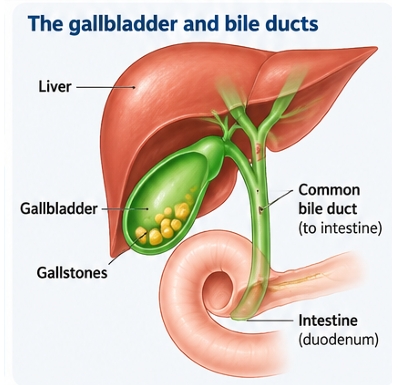
Gallstones form when substances in bile crystallise inside the gallbladder. Many people never know they have
them. Others develop biliary pain, acute cholecystitis, stones in the common bile duct or gallstone pancreatitis.
What does typical gallstone pain feel like?
Biliary colic is usually a steady, significant pain in the upper abdomen - often under the right ribs or in the upper
middle abdomen - and may radiate to the back or right shoulder. Nausea is common. Indigestion and vague
bloating have many other causes, so removing the gallbladder is less likely to help when symptoms are not typical.
Do silent gallstones need surgery?
Usually not. Gallstones discovered incidentally in a person with no biliary symptoms are generally observed rather
than removed, although selected exceptions exist.
When do I usually recommend surgery?
Laparoscopic cholecystectomy is commonly recommended for recurrent typical biliary colic and for complications
such as acute cholecystitis, gallstone pancreatitis or clinically important common bile duct stones after the duct has
been appropriately managed.
What happens during laparoscopic cholecystectomy?
The gallbladder is removed through small abdominal incisions. The cystic duct and cystic artery are carefully
identified. In my practice, I also perform an intraoperative cholangiogram during the procedure before completing
the gallbladder removal.
What is an intraoperative cholangiogram?
An intraoperative cholangiogram (IOC) is an X-ray study of the bile ducts performed during the operation. Contrast
is introduced through the cystic duct and X-ray images outline the biliary tree. In my practice, this is a routine part
of laparoscopic cholecystectomy. It helps confirm the bile-duct anatomy and can reveal a stone within the common
bile duct that was not recognised before surgery.
What if the cholangiogram shows a bile duct stone?
The next step depends on the size and position of the stone, the anatomy and the available expertise. The duct
may be managed during the same operation in selected cases, or an endoscopic procedure such as ERCP may be
required.
What happens after the gallbladder is removed?
Bile continues to be produced by the liver and flows directly into the intestine. Most patients return to a normal diet.
A minority notice temporary loose stools or food sensitivity, particularly early after surgery.
Frequently Asked Questions
If I have one painful attack, must I have surgery?
Not automatically. The pattern of pain, ultrasound findings, your health and the likelihood of another attack all
matter.
Does every surgeon perform a cholangiogram?
Practice varies. In my practice, I routinely perform an intraoperative cholangiogram as part of laparoscopic
cholecystectomy.
Can I live normally without a gallbladder?
Yes. The liver continues to make bile, and most people have no long-term dietary restriction.
The key message
Gallstones need treatment when they are causing a clinical problem - not simply because they appear on
an ultrasound. When I perform laparoscopic cholecystectomy, intraoperative cholangiography is routinely
included in my operative technique
Dr. Mohammed Alassaf
Consultant Bariatric & Gastrointestinal Surgeon
Dr. Alassaf is a leading expert in minimally invasive and bariatric surgery,
with extensive experience helping patients overcome obesity and related conditions.
Having completed advanced training in Australia and the Middle East, he is known
for his compassionate approach and evidence-based surgical care.