Laparoscopic Surgery for Gastric Cancer: What Patients Need to Know
Gastric Cancer & Laparoscopic Gastrectomy
Laparoscopic Surgery for Gastric Cancer: What Patients Need to Know
Dr-Alassaf
Nov 11, 2026
Being told that you need surgery for stomach cancer naturally raises many questions. One of them may be
whether the operation can be performed using laparoscopic (keyhole) surgery rather than through a
traditional open incision.
For appropriately selected patients, laparoscopic gastrectomy can allow the surgeon to perform the
essential cancer operation through several small incisions. Importantly, laparoscopic surgery describes
how the operation is performed - not how extensive the cancer operation is.
What does surgery for gastric cancer involve?
The aim of surgery is to remove the cancer completely, together with an appropriate margin of healthy
stomach and the surrounding lymph nodes.
Depending on where the tumor is located and how much of the stomach needs to be removed, the
operation may involve a distal gastrectomy, in which the lower portion of the stomach is removed, or a
total gastrectomy, in which the entire stomach is removed.
The lymph nodes surrounding the stomach and its major blood vessels are also removed in a systematic
lymph-node dissection (lymphadenectomy). This is an important part of the cancer operation and helps both
treat the disease and determine its final pathological stage.
What is laparoscopic gastrectomy?
Instead of making one long abdominal incision, the surgeon operates through several small openings in the
abdomen. A camera provides a magnified view, while specialized instruments are used to separate the
stomach, divide the appropriate blood vessels, remove the required lymph nodes, and remove the part - or
all - of the stomach containing the cancer.
The digestive tract is then reconstructed so that food can continue to pass through it. The fundamental
cancer operation should not be reduced simply because the procedure is being performed
laparoscopically.
How is the operation performed?
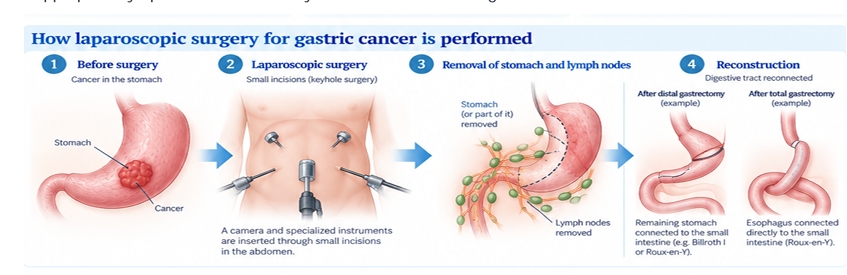
The exact operation depends on the location and stage of the tumor. The illustration below shows the
general sequence: laparoscopic access, removal of the cancer-bearing portion of stomach together with the
appropriate lymph nodes, followed by reconstruction of the digestive tract.
Is laparoscopic surgery as effective as open surgery for cancer?
For appropriately selected patients, modern randomized trials have shown that laparoscopic distal
gastrectomy can achieve long-term cancer outcomes comparable with open surgery in both early and
selected locally advanced gastric cancer. The evidence is not identical for every tumor location, stage, or
type of gastrectomy, so the surgical approach still needs to be individualized.
What are the potential advantages?
Because the operation is performed through smaller incisions, patients may experience less postoperative
pain and earlier mobilization, and recovery can sometimes be faster. The smaller abdominal wounds are
also cosmetically less noticeable.
However, these benefits are secondary to the main objective: performing a safe and complete cancer
resection. A laparoscopic operation should be chosen because the required cancer surgery can be
achieved safely - not simply because the incisions are smaller.
Who is suitable for laparoscopic surgery?
The decision depends on factors including the location and stage of the tumor, whether part or all of the
stomach needs to be removed, previous abdominal operations, the patient's general health, and the
surgeon's experience with advanced laparoscopic gastric surgery.
Very large tumors, involvement of neighboring organs, unexpected findings during surgery, or other
technical considerations may make an open operation more appropriate. Occasionally, an operation that
begins laparoscopically needs to be converted to an open operation. This may simply be the safest way to
complete the cancer operation.
What happens to the stomach afterward?
After a distal gastrectomy, the remaining stomach is connected back to the digestive tract. After a total
gastrectomy, the esophagus is connected directly to the small intestine. Food can therefore still pass
through the digestive system even though the stomach has been removed. The exact method of
reconstruction varies according to the operation and the individual patient's anatomy.
Will I be able to eat normally?
Most patients are able to return to regular foods, but eating patterns usually change after gastrectomy.
Initially, meals are small and gradually increased. In the longer term, many patients tolerate smaller, more
frequent meals better than large meals.
Weight loss is common after gastric surgery, particularly after total gastrectomy. Some patients may
develop dumping symptoms related to rapid passage of food into the intestine. Nutritional monitoring is
therefore an important part of recovery. After total gastrectomy, lifelong vitamin B12 replacement is
required, and iron, folate, vitamin D, calcium, and other nutritional parameters may also need monitoring.
What are the risks of the operation?
Gastrectomy is a major operation regardless of whether it is performed laparoscopically or through an open
incision. Possible complications include bleeding, infection, blood clots, chest complications, leakage from
one of the surgical connections, delayed stomach emptying after some partial gastrectomies, bowel
obstruction, and nutritional problems.
The individual risk depends on the extent of surgery, the patient's health, previous treatment, and the
complexity of the cancer.
Will I need chemotherapy as well?
Surgery is often only one part of gastric-cancer treatment. Depending on the stage and biological
characteristics of the cancer, chemotherapy may be recommended before surgery, after surgery, or both. In
some situations other systemic treatments may also be appropriate. The treatment plan is usually
determined by a multidisciplinary cancer team.
Whether the operation is laparoscopic or open generally does not determine whether additional cancer
treatment is required.
What happens after surgery?
Recovery varies according to whether a partial or total gastrectomy has been performed and according to
the individual patient. Patients are encouraged to walk early after surgery. Drinking and eating are gradually
reintroduced according to the surgical team's protocol, and activity is increased after discharge while
nutritional intake and weight are monitored.
The final pathology report provides important information about the tumor and lymph nodes and helps
determine whether further treatment is necessary.
Frequently Asked Questions
Does laparoscopic surgery mean that less of the cancer is removed?
No. The aim is to perform the same appropriate cancer resection, including removal of the necessary
stomach and lymph nodes. The difference is primarily the route used to perform the operation.
Are small incisions always better?
Not necessarily. The priority is complete and safe cancer surgery. In some situations an open operation is
the more appropriate approach.
Can the surgeon change from laparoscopic to open surgery during the operation?
Yes. Conversion may occasionally be necessary because of anatomy, adhesions, bleeding, tumor extent, or
another unexpected finding. The decision is made when an open approach is considered safer or more
appropriate for completing the operation.
Can the whole stomach be removed laparoscopically?
Yes. Laparoscopic total gastrectomy can be performed in selected patients by surgeons experienced in the
procedure. The evidence base and technical considerations differ somewhat from those for laparoscopic
distal gastrectomy, so patient selection remains important.
Will I still need follow-up after the cancer is removed?
Yes. Follow-up after gastric-cancer treatment is important for monitoring recovery, nutrition, and possible
recurrence. The appropriate schedule depends on the cancer stage and treatment received.
The key message
Laparoscopic surgery does not mean a smaller cancer operation.
For appropriately selected patients, an experienced surgeon can remove the required portion of stomach
and lymph nodes through a minimally invasive approach while maintaining the principles of cancer surgery.
The most important question is therefore not simply "Can my operation be done laparoscopically?" but
rather "Which approach allows my cancer to be removed safely, completely, and appropriately?"
This article is for general educational purposes and does not replace an individualized consultation with a qualified surgeon or
multidisciplinary cancer team.
Dr. Mohammed Alassaf
Consultant Bariatric & Gastrointestinal Surgeon
Dr. Alassaf is a leading expert in minimally invasive and bariatric surgery,
with extensive experience helping patients overcome obesity and related conditions.
Having completed advanced training in Australia and the Middle East, he is known
for his compassionate approach and evidence-based surgical care.