Gallbladder Polyps: When Should the Gallbladder Be Removed?
Gallbladder Polyps & Gallbladder Cancer Risk
Gallbladder Polyps: When Should the Gallbladder Be Removed?
Dr-Alassaf
Nov 07, 2026
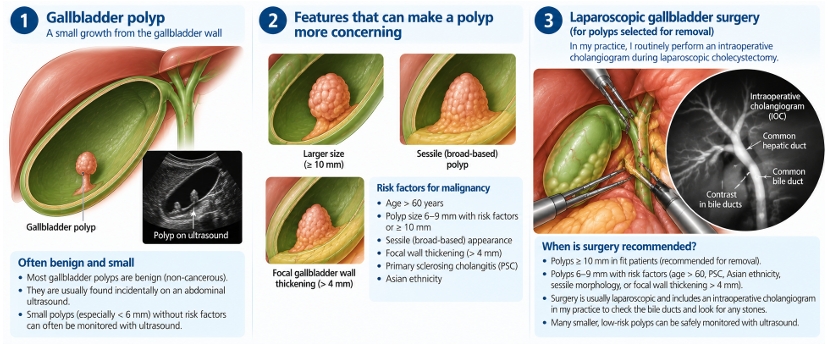
A gallbladder polyp is a small growth projecting from the inner wall of the gallbladder. They are commonly discovered by chance during an ultrasound performed for another reason. The reassuring point is that most small gallbladder polyps are benign; the challenge is identifying the minority that deserve closer follow-up or removal.
Are all gallbladder polyps precancerous?
No. Many ultrasound-detected polyps are cholesterol polyps or other non-neoplastic lesions rather than true tumours. Small polyps, particularly those with reassuring morphology, have a very low risk of malignancy. This is why finding a polyp does not automatically mean that the gallbladder should be removed.
How are gallbladder polyps assessed?
Abdominal ultrasound is the usual first investigation. The report should describe the size and appearance of the lesion and whether there is associated gallbladder wall thickening. Previous scans are useful because they allow us to assess whether the lesion is stable or growing.
In difficult or uncertain cases, more specialised imaging - such as high-quality repeat ultrasound, contrast-enhanced ultrasound or endoscopic ultrasound - may sometimes help clarify the finding, but these tests are not routinely required for every polyp.
When is surgery generally recommended?
One widely used European guideline recommends cholecystectomy for a gallbladder polyp measuring 10 mm or more in a patient who is fit for and accepts surgery. For polyps measuring 6-9 mm, the same guideline recommends surgery when important malignancy risk factors are present.
Those European risk factors include age over 60 years, primary sclerosing cholangitis (PSC), Asian ethnicity, and a sessile or broad-based polyp - including focal gallbladder wall thickening greater than 4 mm. Symptoms potentially attributable to the gallbladder may also support cholecystectomy when another cause has not been found.
Why is there sometimes disagreement about the size threshold?
Not all professional guidance uses exactly the same thresholds. The Society of Radiologists in Ultrasound (SRU) takes a more morphology-based approach to incidentally detected polyps and generally uses higher size thresholds for surgical consultation in low-risk lesions. More recent Canadian radiology recommendations have also moved toward the SRU approach to reduce unnecessary surveillance and surgery.
For patients, this means that a measurement alone should not be interpreted in isolation. The appearance of the polyp, its growth, the patient's risk factors, symptoms and the quality of the ultrasound all matter.
What if the polyp is smaller than 10 mm?
Many smaller low-risk polyps can be monitored rather than removed. Under the 2022 European joint guideline, a 6-9 mm polyp without malignancy risk factors is followed by ultrasound at 6 months, 1 year and 2 years; surveillance can stop after 2 years if there is no concerning growth. A polyp 5 mm or smaller without risk factors does not require follow-up under that guideline.
If a polyp reaches 10 mm during European-guideline surveillance, cholecystectomy is advised. Growth of 2 mm or more over the 2-year follow-up period prompts reassessment of the current size together with the patient's risk factors rather than automatically meaning cancer.
Does a growing polyp mean cancer?
No. Benign polyps can grow, and small changes can also reflect measurement variation between ultrasound examinations. Growth is therefore a reason to reassess the entire picture, not a diagnosis of cancer.
What happens if surgery is recommended?
The operation is usually a laparoscopic cholecystectomy: the entire gallbladder is removed rather than attempting to remove the polyp alone. The specimen is then examined by a pathologist, which provides the definitive diagnosis.
In my practice, I routinely perform an intraoperative cholangiogram during laparoscopic cholecystectomy. Contrast is introduced through the cystic duct and X-ray imaging outlines the bile ducts, providing an additional assessment of the biliary anatomy and allowing unsuspected common bile duct stones to be identified.
What if the ultrasound looks suspicious for cancer?
A lesion that appears clearly suspicious for gallbladder cancer should not simply be treated as an ordinary benign polyp. Further staging and specialist hepatobiliary assessment may be required because the surgical strategy for suspected gallbladder cancer can be different from a routine cholecystectomy.
Frequently Asked Questions
I have a 4 mm polyp. Do I need my gallbladder removed?
Usually not on size alone. In a patient without important risk factors, very small polyps generally do not require surgery and may not require surveillance, depending on the guideline being followed.
I have a 7 mm polyp. Does that mean I need surgery?
Not necessarily. Under European guidance, a 6-9 mm polyp is usually monitored if there are no malignancy risk factors, but cholecystectomy is recommended when specified risk factors are present. Other guidelines use somewhat different thresholds.
Can a biopsy be taken from the polyp before surgery?
Routine needle biopsy of a gallbladder polyp is generally not how these lesions are managed. Assessment is based mainly on imaging and risk features; when the gallbladder is removed, the final diagnosis comes from pathological examination of the specimen.
If my gallbladder is removed for a polyp, will you perform a cholangiogram?
Yes. In my practice, intraoperative cholangiography is routinely performed during laparoscopic cholecystectomy.
The key message
Most gallbladder polyps are benign and do not automatically require surgery. Management depends on size, morphology, growth and individual risk factors. When cholecystectomy is appropriate, I perform the operation laparoscopically and routinely incorporate an intraoperative cholangiogram into my operative technique.
This article is for general patient education and does not replace individual assessment or advice from your treating surgical team.
Dr. Mohammed Alassaf
Consultant Bariatric & Gastrointestinal Surgeon
Dr. Alassaf is a leading expert in minimally invasive and bariatric surgery,
with extensive experience helping patients overcome obesity and related conditions.
Having completed advanced training in Australia and the Middle East, he is known
for his compassionate approach and evidence-based surgical care.