Skin Cancer Surgery: Understanding Excision and Surgical Margins
Skin Cancer & Surgical Excision and Margins
Skin Cancer Surgery: Understanding Excision and Surgical Margins
Dr-Alassaf
Nov 07, 2026
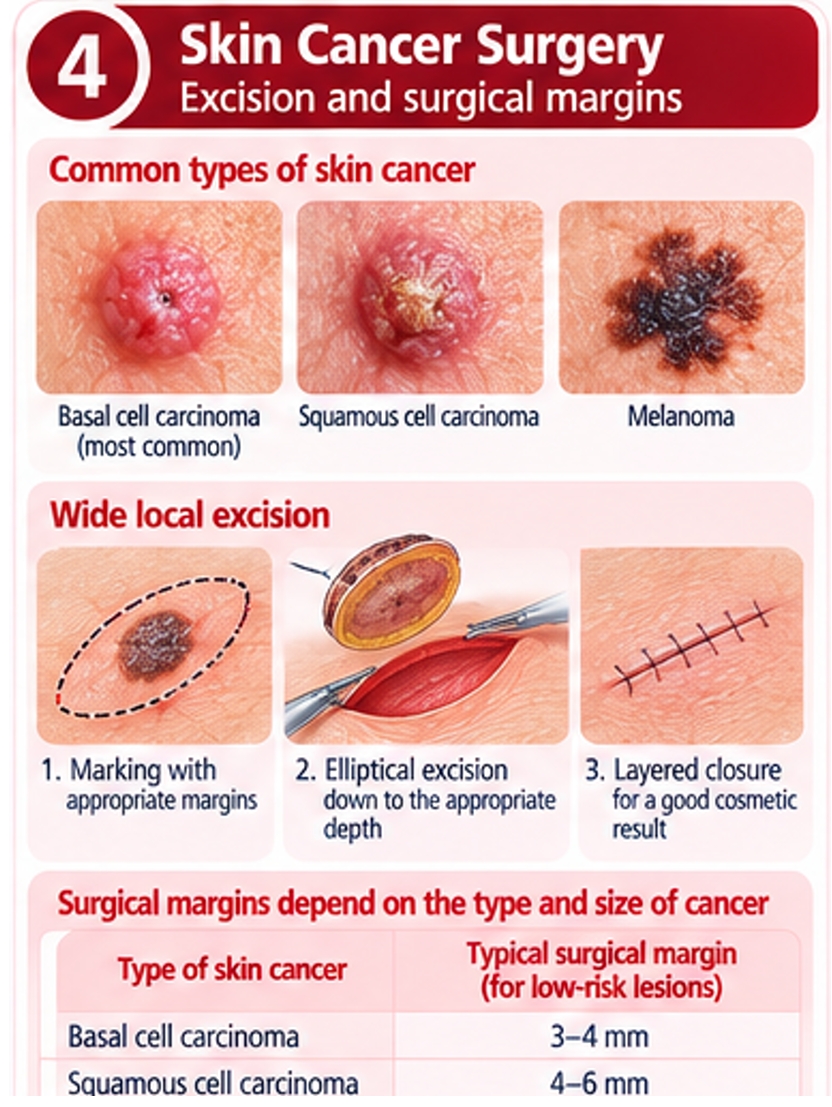
Most common skin cancers are treated very effectively with surgery. The aim is to remove the tumour completely with an appropriate rim of clinically normal skin while preserving as much healthy tissue and function as possible. The required margin depends on the cancer type, site and risk features.
Which skin cancers are commonly treated surgically?
Basal cell carcinoma and cutaneous squamous cell carcinoma are the commonest. Melanoma is also primarily treated surgically but follows a different margin and lymph-node pathway, which is covered separately.
What is a surgical margin?
A margin is the rim of apparently normal tissue removed around a visible cancer. It accounts for microscopic tumour cells that may extend beyond what can be seen.
How are margins chosen?
Margins depend on tumour type, size, location, borders and pathological risk. Low-risk basal and squamous cancers can often be treated with standard excision, while higher-risk lesions may require wider or margin-controlled surgery.
What happens during excision?
The lesion and planned margin are marked, local anaesthetic is given, and the specimen is removed to the appropriate depth. The specimen is orientated when necessary and sent to pathology to assess diagnosis and margin clearance.
How is the wound closed?
Small defects can often be closed directly in layers. Larger defects or anatomically difficult sites may require a local skin flap or skin graft. Reconstruction is planned to preserve function as well as appearance.
What if the pathology margin is involved?
Further treatment may be recommended because tumour remains at or very near the cut edge. Depending on tumour type and location, this may mean re-excision or a margin-controlled technique.
What is Mohs surgery?
Mohs micrographic surgery removes the cancer in stages while examining the margins during the procedure. It is particularly useful for selected high-risk tumours or sites where tissue preservation is important.
What follow-up is needed?
Follow-up depends on cancer type and risk. Patients should also learn sun protection and self-examination because one skin cancer increases the likelihood of developing another.
Frequently Asked Questions
Does a wider margin always mean better treatment?
No. The correct evidence-based margin balances cancer clearance with preservation of healthy tissue.
Will every skin cancer need a graft?
No. Many wounds close directly; reconstruction depends on defect size and location.
Can skin cancer return after excision?
Yes, although complete appropriate excision gives excellent control for many lesions. Higher-risk tumours need closer follow-up.
The key message
Good skin-cancer surgery removes the tumour with an appropriate oncological margin and then reconstructs the defect with attention to function and appearance. The required margin is determined by the specific cancer, not by one universal number.
This article is for general patient education and does not replace individual examination, pathology review or advice from your treating surgeon or dermatologist
Dr. Mohammed Alassaf
Consultant Bariatric & Gastrointestinal Surgeon
Dr. Alassaf is a leading expert in minimally invasive and bariatric surgery,
with extensive experience helping patients overcome obesity and related conditions.
Having completed advanced training in Australia and the Middle East, he is known
for his compassionate approach and evidence-based surgical care.