Common Bile Duct Stones: What Happens If a Stone Leaves the Gallbladder?
Common Bile Duct Stones & Biliary Tract Disease
Common Bile Duct Stones: What Happens If a Stone Leaves the Gallbladder?
Dr-Alassaf
Nov 07, 2026
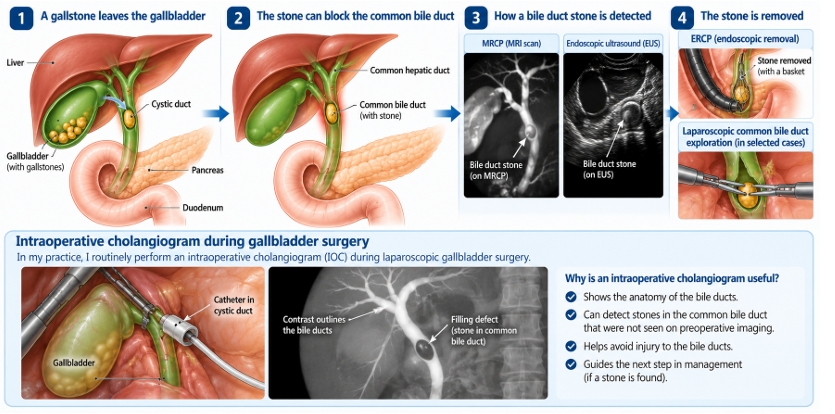
A gallstone can leave the gallbladder and enter the common bile duct - the channel that carries bile from the liver into the intestine. Some stones pass spontaneously, but others obstruct the duct and can cause jaundice, infection or pancreatitis.
What symptoms can a common bile duct stone cause?
A bile duct stone may cause upper abdominal pain similar to gallstone pain. If it obstructs bile flow, the eyes and skin can become yellow, the urine may become dark and the stools pale. Liver blood tests often become abnormal.
If obstruction becomes infected, acute cholangitis can develop, with fever, pain, jaundice and potentially sepsis. A stone at the lower end of the bile duct can also trigger acute pancreatitis.
How do we know whether a stone is in the bile duct?
Ultrasound and liver blood tests are usually the starting point. A dilated bile duct, abnormal liver tests, jaundice or a stone seen on imaging increases the suspicion.
When the probability is intermediate, MRCP or endoscopic ultrasound (EUS) can confirm the diagnosis without exposing the patient to the risks of a diagnostic ERCP. Current ASGE guidance supports MRCP or EUS for intermediate-risk patients. Patients with clear high-risk features may proceed directly to therapeutic ERCP.
What is ERCP?
ERCP is an endoscopic procedure used mainly to treat bile duct obstruction. The endoscope is passed through the mouth into the duodenum, the bile duct is entered, and stones can be removed using balloons or baskets. A sphincterotomy is often performed.
ERCP is highly useful when treatment is required, but it is not risk-free. Complications include pancreatitis, bleeding, infection and perforation. This is why MRCP or EUS is often preferred when the diagnosis is uncertain rather than performing ERCP simply to look for a stone.
Can the stone be removed during gallbladder surgery?
Yes, in selected patients and when the necessary expertise and equipment are available. Laparoscopic common bile duct exploration can clear stones through the cystic duct or, in more complex situations, through an opening in the common bile duct. SAGES notes that the choice between laparoscopic treatment and ERCP depends substantially on stone characteristics, anatomy, local expertise and resources.
How does the intraoperative cholangiogram fit into my operation?
In my practice, I routinely perform an intraoperative cholangiogram during laparoscopic cholecystectomy. A small catheter is introduced through the cystic duct, contrast is injected and X-ray imaging outlines the biliary tree.
This allows me to assess the bile-duct anatomy during the operation and may reveal a filling defect caused by a common bile duct stone that was not detected before surgery. If a stone is found, the next step is selected according to its size and position, the duct anatomy and the safest available method of clearance.
If ERCP clears the duct, do I still need my gallbladder removed?
Usually yes, if the duct stone originated from gallstones and the patient is fit for surgery. ERCP removes the stone from the duct but leaves the gallbladder - and therefore the source of further stones - in place. Cholecystectomy is commonly performed during the same admission or soon afterwards depending on the clinical presentation.
What happens in gallstone pancreatitis?
If pancreatitis is caused by a gallstone but there is no ongoing bile-duct obstruction or cholangitis, urgent ERCP is not routinely required. In mild gallstone pancreatitis, current guidance supports cholecystectomy during the same admission once the patient is clinically suitable.
Frequently Asked Questions
Does every suspected bile duct stone need ERCP?
No. MRCP or EUS is often used first when the probability is intermediate. ERCP is best reserved for patients in whom endoscopic treatment is likely to be required.
Can a bile duct stone pass by itself?
Yes, particularly a small stone, but it is not safe to assume that this has happened when there are persistent symptoms, jaundice, abnormal blood tests or duct dilation.
What happens if your intraoperative cholangiogram shows a stone?
Management is individualised. Depending on the stone and the circumstances, options include laparoscopic duct clearance, intraoperative endoscopic treatment or ERCP after surgery.
Does clearing the bile duct cure the gallstone problem?
It treats the duct obstruction, but the gallbladder generally remains the source of future stones. In a suitable patient, gallbladder removal is therefore usually still required.
The key message
A common bile duct stone can cause jaundice, cholangitis or pancreatitis and should be treated differently from a stone confined to the gallbladder. Diagnosis should avoid unnecessary ERCP, and treatment can be endoscopic or laparoscopic. In my practice, routine intraoperative cholangiography provides an additional assessment of the biliary tree during laparoscopic cholecystectomy.
This article is for general patient education and does not replace individual assessment or advice from your treating surgical team.
Dr. Mohammed Alassaf
Consultant Bariatric & Gastrointestinal Surgeon
Dr. Alassaf is a leading expert in minimally invasive and bariatric surgery,
with extensive experience helping patients overcome obesity and related conditions.
Having completed advanced training in Australia and the Middle East, he is known
for his compassionate approach and evidence-based surgical care.