Acute Cholecystitis: When Does an Inflamed Gallbladder Need Surgery?
Acute Cholecystitis & Gallbladder Inflammation
Acute Cholecystitis: When Does an Inflamed Gallbladder Need Surgery?
Dr-Alassaf
Nov 07, 2026
Do you perform a cholangiogram in acute cholecystitis?
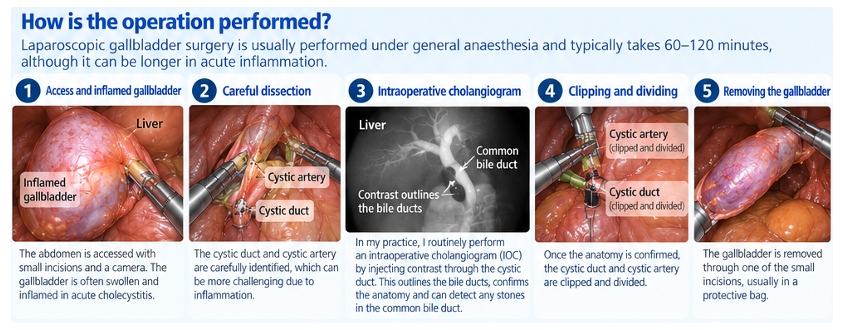
Yes. In my practice, I routinely perform an intraoperative cholangiogram (IOC) during laparoscopic
cholecystectomy, including operations for acute cholecystitis. Contrast is introduced through the cystic duct and
X-ray imaging outlines the biliary tree.
This is particularly useful in an inflamed gallbladder because inflammation can distort the normal anatomy. IOC
provides an additional assessment of the bile-duct anatomy and may also demonstrate an unsuspected common
bile duct stone. Multi-society guidance specifically supports liberal use of IOC in acute cholecystitis, although
recommendations are conditional because the certainty of evidence is limited.
What if the gallbladder is too inflamed to remove safely in the usual way?
Safety takes priority over completing a standard total cholecystectomy. If the anatomy cannot be identified safely,
the surgeon may change the dissection strategy, perform a subtotal cholecystectomy, obtain additional biliary
imaging or convert to an open operation. These are safety decisions rather than failures of laparoscopic surgery.
What if there is a common bile duct stone?
If investigations or the intraoperative cholangiogram demonstrate a common bile duct stone, the duct also needs
appropriate treatment. Depending on the stone, anatomy and available expertise, this may involve laparoscopic
bile-duct clearance or ERCP.
What about patients who are too unwell for immediate surgery?
A small group of critically ill or very high-risk patients may initially be treated with antibiotics, supportive care and
drainage of the gallbladder when necessary. Percutaneous cholecystostomy can be used as a temporising
measure in selected patients who are not suitable for immediate cholecystectomy. The need and timing of later
definitive surgery are then reassessed.
What should I expect after surgery?
Many patients improve quickly once the inflamed gallbladder has been removed, although recovery can be slower
than after an uncomplicated elective operation. Hospital stay depends on the severity of inflammation, the difficulty
of surgery, associated infection and any bile-duct problem. Walking and oral intake are restarted as the patient's
condition allows.
Frequently Asked Questions
Can antibiotics cure acute cholecystitis without surgery?
Antibiotics and supportive treatment can settle infection and inflammation, but they do not remove the gallstones or
the diseased gallbladder. In a patient fit for surgery, cholecystectomy is generally the definitive treatment.
Is surgery more difficult during an acute attack?
It can be. Swelling, inflammation and scarring may make the anatomy more difficult to define. This is why careful
dissection, safe anatomical identification and an appropriate bailout strategy are important.
Does everyone need an open operation if the gallbladder is severely inflamed?
No. Many acute cases can still be completed laparoscopically. An open or subtotal approach is used selectively
when it offers the safer route.
Why do you perform an intraoperative cholangiogram?
In my practice, IOC is routinely used to provide an additional view of the biliary anatomy and to look for common
bile duct stones. This can be particularly valuable when acute inflammation has distorted the normal anatomy.
The key message
Acute cholecystitis is usually more than a simple gallstone attack. For most suitable patients,
laparoscopic removal of the gallbladder during the acute admission provides definitive treatment. The
operation must be adapted to the degree of inflammation, and in my practice routine intraoperative
cholangiography forms part of the safety-focused approach.
This article is for general patient education and does not replace individual assessment or advice from your treating surgical team.
Dr. Mohammed Alassaf
Consultant Bariatric & Gastrointestinal Surgeon
Dr. Alassaf is a leading expert in minimally invasive and bariatric surgery,
with extensive experience helping patients overcome obesity and related conditions.
Having completed advanced training in Australia and the Middle East, he is known
for his compassionate approach and evidence-based surgical care.