Surgery for Oesophageal Cancer: What Patients Need to Know
Oesophageal Cancer & Surgical Treatment
Surgery for Oesophageal Cancer: What Patients Need to Know
Dr-Alassaf
Nov 11, 2026
Oesophageal cancer develops in the tube that carries food from the mouth to the stomach. The two main
types are adenocarcinoma and squamous cell carcinoma. Treatment depends on the type of cancer, its
location and stage, and the patient's general health.
For some patients with cancer that has not spread to distant organs, surgery offers an important opportunity
to remove the tumour. For locally advanced disease, surgery is usually one part of a broader treatment plan
that may also include chemotherapy or chemoradiotherapy.
Who may need surgery?
Not every oesophageal cancer requires an oesophagectomy. Some very early cancers can be removed
endoscopically without removing the oesophagus. At the other end of the spectrum, cancers that have
spread to distant organs are generally treated primarily with systemic treatment rather than major resection.
When the cancer is considered resectable, the decision about surgery is made after staging and
multidisciplinary assessment. The aim is to determine whether the tumour can be removed completely and
whether the patient is fit enough to benefit from a major operation.
What tests are usually needed?
Evaluation commonly includes upper endoscopy with biopsy, CT imaging and, in appropriate patients,
PET-CT and endoscopic ultrasound. These tests help determine where the tumour is, how deeply it has
grown, whether lymph nodes are involved, and whether there is evidence of spread elsewhere.
Nutrition, heart and lung function, physical fitness and other medical conditions are also important because
oesophagectomy is a major operation.
Will I need treatment before surgery?
Many patients with locally advanced resectable oesophageal cancer receive treatment before the operation.
Depending on the cancer type and location, this may involve chemotherapy given around the time of
surgery or chemotherapy combined with radiotherapy before surgery.
For locally advanced oesophageal or oesophagogastric-junction adenocarcinoma, contemporary treatment
increasingly uses perioperative chemotherapy in appropriate patients. Treatment remains individualized
according to tumour biology, stage, patient factors and multidisciplinary-team recommendations.
What is an oesophagectomy?
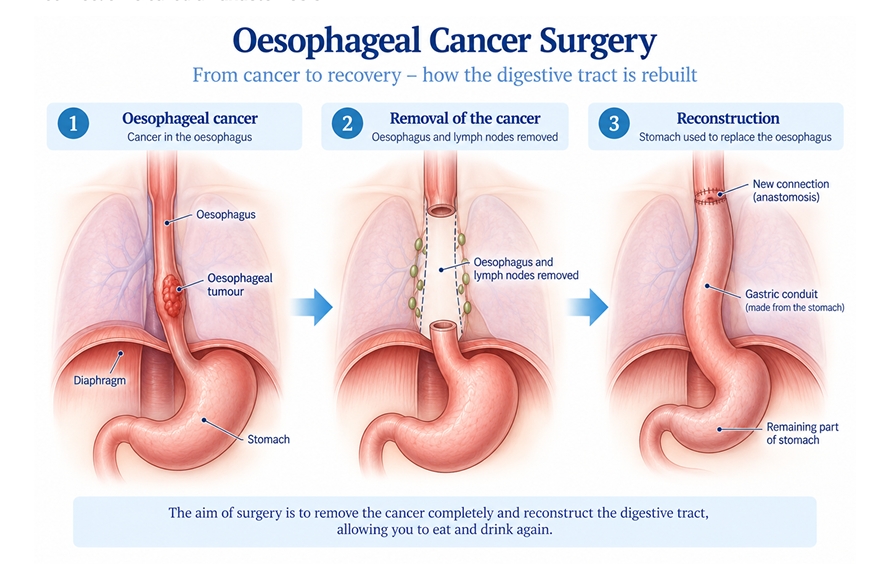
An oesophagectomy removes the part of the oesophagus containing the cancer together with surrounding
tissue and an appropriate lymph-node dissection. Part of the upper stomach is usually removed as well.
The remaining stomach is then reshaped into a narrow tube, called a gastric conduit, and brought upward
into the chest - and sometimes the neck - where it is joined to the remaining oesophagus. This new
connection is called an anastomosis.
Simplified illustration of oesophagectomy. The exact extent of oesophageal and stomach removal, lymph-node dissection and level of
reconstruction varies according to tumour location and the individual operation.
What is minimally invasive oesophagectomy?
In minimally invasive oesophagectomy, much of the operation is performed through small abdominal and
chest incisions using a camera and specialized instruments. Robotic systems may also be used in
experienced centres.
The purpose of minimally invasive surgery is not to perform a smaller cancer operation. The same principles
of complete tumour removal, adequate margins and lymph-node dissection remain essential. Current
European guidance supports minimally invasive oesophagectomy as the preferred surgical approach in
experienced centres.
What are the possible advantages of minimally invasive surgery?
Smaller incisions may reduce some of the physical impact of the operation. Clinical trials have shown
benefits including fewer postoperative pulmonary complications with minimally invasive approaches.
Recovery, however, still reflects the fact that oesophagectomy is a major operation involving both the chest
and abdomen.
What are the important risks?
Complications can occur even when surgery is performed carefully. Important risks include bleeding,
infection, pneumonia and other chest complications, blood clots, heart rhythm problems, and leakage from
the new connection between the oesophagus and stomach.
The new connection can occasionally narrow during healing, causing swallowing difficulty. Delayed
emptying of the gastric conduit, reflux, nutritional problems and injury to nearby structures are other
recognized complications. Individual risk depends on age, general health, nutrition, tumour treatment and
the complexity of the operation.
What happens after surgery?
Patients are encouraged to sit out of bed, walk and perform breathing exercises early. Pain control and
chest physiotherapy are important. Fluids and food are introduced according to the surgical team's protocol,
and nutritional support may be used while recovery progresses.
Hospital stay varies considerably. Recovery continues after discharge, and strength and appetite generally
improve gradually over the following weeks and months.
Will I be able to eat normally?
Most patients are able to eat and drink after recovery, but eating habits usually change. Because the
stomach has been reshaped and moved into the chest, smaller and more frequent meals are generally
better tolerated than large meals.
Early fullness, weight loss, reflux, dumping symptoms and altered appetite can occur. Dietetic support and
nutritional monitoring are therefore important parts of recovery.
What happens after the final pathology result?
The removed oesophagus, stomach tissue and lymph nodes are examined by a pathologist. The final report
describes how deeply the cancer had grown, whether lymph nodes contained cancer, whether the resection
margins are clear and how the tumour responded to treatment given before surgery.
These findings help the multidisciplinary team decide whether additional treatment is recommended and
guide the follow-up plan.
Frequently Asked Questions
Does minimally invasive surgery mean that less cancer is removed?
No. The intention is to perform the same appropriate cancer resection and lymph-node dissection through a
minimally invasive approach. Cancer clearance takes priority over incision size.
Is the whole oesophagus removed?
Not necessarily. The extent of removal depends on the tumour's location and the operation being
performed. A substantial portion of the oesophagus is usually removed, while enough healthy oesophagus
is retained to create the new connection.
What replaces the oesophagus?
In most patients, the stomach is reshaped into a narrow tube and brought upward to replace the removed
oesophagus. In selected situations, another part of the intestine may be used instead.
Can surgery start minimally invasively and become an open operation?
Yes. Conversion to an open operation may occasionally be the safest way to manage bleeding, difficult
anatomy, adhesions, unexpected tumour findings or another technical problem. The priority is completing
the cancer operation safely.
Will I need chemotherapy after surgery?
That depends on the cancer type, treatment already received and the final pathology. Some treatment
strategies include chemotherapy both before and after surgery, while other patients may require different
postoperative treatment or surveillance.
How long does recovery take?
Recovery is gradual and differs considerably between patients. Walking and basic activities begin early, but
rebuilding stamina, adapting to new eating patterns and recovering weight can take several months.
The key message
Oesophagectomy is a major cancer operation, but minimally invasive techniques can allow it to be
performed through smaller incisions without reducing the principles of cancer surgery.
The operation removes the cancer-bearing oesophagus and appropriate lymph nodes, then reconstructs the
digestive tract - usually by using the stomach as a new oesophageal conduit.
The most important questions are whether the cancer can be removed completely, what additional cancer
treatment is required, and which surgical approach can achieve that safely for the individual patient.
This article is for general educational purposes and does not replace an individualized consultation with a qualified surgeon, oncologist
or multidisciplinary cancer team.
Dr. Mohammed Alassaf
Consultant Bariatric & Gastrointestinal Surgeon
Dr. Alassaf is a leading expert in minimally invasive and bariatric surgery,
with extensive experience helping patients overcome obesity and related conditions.
Having completed advanced training in Australia and the Middle East, he is known
for his compassionate approach and evidence-based surgical care.