Heller Myotomy for Achalasia: What Patients Need to Know
Achalasia & Oesophageal Motility Disorders
Heller Myotomy for Achalasia: What Patients Need to Know
Dr-Alassaf
Nov 10, 2026
If you have been diagnosed with achalasia, you may have been told that a Heller myotomy is one of the
treatment options. The purpose of this operation is to make swallowing easier by releasing the tight muscle
at the lower end of the esophagus.
Achalasia is a disorder of esophageal movement. The lower esophageal sphincter does not relax normally,
and the body of the esophagus also loses much of its normal coordinated movement. Food and liquids can
therefore have difficulty passing into the stomach.
What symptoms can achalasia cause?
Common symptoms include difficulty swallowing liquids and solids, regurgitation of undigested food or
saliva, chest discomfort, coughing or choking - particularly at night - and weight loss in some patients.
Symptoms vary considerably from person to person.
What is a Heller myotomy?
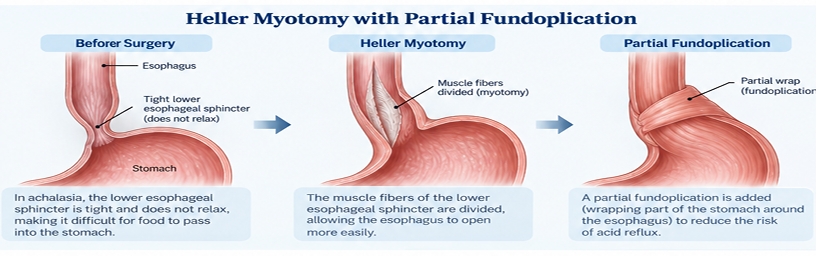
A Heller myotomy is an operation in which the surgeon carefully divides the muscle fibers of the lower
esophagus and the lower esophageal sphincter. The inner lining of the esophagus is left intact. Releasing
these muscle fibers reduces the resistance at the junction between the esophagus and stomach, allowing
food and liquids to pass more freely.
The operation is usually performed using minimally invasive laparoscopic or robotic techniques through
several small abdominal incisions.
Why is a fundoplication often added?
The lower esophageal sphincter normally helps prevent stomach contents from refluxing into the
esophagus. Because a Heller myotomy weakens this barrier, a partial fundoplication is commonly added.
This uses part of the upper stomach to create a gentle anti-reflux mechanism without making the junction
excessively tight.
Dr. Mohammad Alassaf
What happens during the operation?
The lower esophagus and upper stomach are exposed. The surgeon then divides the muscle fibers along
the lower esophagus and extends the myotomy a short distance onto the stomach. A partial fundoplication
is usually fashioned afterward to reduce postoperative reflux.
Simplified illustration: the tight lower esophageal sphincter is released by myotomy, followed by a partial fundoplication to reduce
Will I be able to swallow normally?
Most patients experience a major improvement in swallowing after Heller myotomy. However, the operation
does not restore normal movement to the esophagus itself. It removes the main obstruction at its lower
end, allowing gravity and the remaining esophageal function to help food enter the stomach more easily.
Some patients may continue to notice occasional difficulty with certain foods. Eating slowly, chewing
thoroughly, and taking fluids with meals may remain helpful.
What tests are needed before surgery?
The exact evaluation depends on the clinical situation. It commonly includes upper endoscopy to examine
the esophagus and stomach, esophageal manometry to confirm the diagnosis and characterize
esophageal function, and a barium swallow or other contrast study to assess emptying and anatomy.
Additional testing may be recommended in selected patients.
What happens after surgery?
Patients usually begin with liquids and gradually progress to soft foods while swelling around the operated
area settles. The surgical team will provide specific dietary instructions. Walking and light activity are
encouraged early, while strenuous activity and heavy lifting are usually restricted during the initial recovery
period.
What are the possible risks?
Heller myotomy is generally a safe and effective operation, but complications can occur. These include
bleeding, infection, injury or a small opening in the lining of the esophagus or stomach, reflux after surgery,
and persistent or recurrent swallowing difficulty. The individual risk depends on the patient's condition,
anatomy, previous treatment, and complexity of the operation.
Dr. Mohammad Alassaf
Can symptoms come back after a Heller myotomy?
Yes. Heller myotomy is intended to provide long-lasting relief, but achalasia is a chronic disorder and
symptoms can recur. Persistent or recurrent difficulty swallowing may have several causes, including
incomplete relief of the obstruction, scarring, reflux-related problems, or progression of the underlying
esophageal dysfunction.
If symptoms return, further assessment may include endoscopy, contrast imaging, manometry, or other
investigations. Additional treatment is sometimes required, but the appropriate approach depends on the
cause of the symptoms.
What can I expect in the long term?
The goal of Heller myotomy is not to cure the abnormal movement of the esophagus. Instead, it creates a
more open passage into the stomach. For appropriately selected patients, this can provide substantial and
durable improvement in swallowing, eating, and quality of life.
Long-term follow-up is important, particularly if swallowing difficulty, regurgitation, reflux, chest symptoms,
or unexplained weight loss develop again.
The key point
Heller myotomy does not make the esophagus move normally again. It releases the tight lower
esophageal sphincter so that food and liquids can pass into the stomach more easily. Understanding this
distinction helps set realistic expectations before surgery.
Frequently Asked Questions
Does Heller myotomy cure achalasia?
It treats the main obstruction caused by the lower esophageal sphincter, but it does not cure the underlying
loss of normal esophageal movement.
Why is a partial fundoplication performed?
Dividing the lower esophageal sphincter can increase the risk of reflux. A partial fundoplication is
commonly added to reduce that risk while trying to preserve easy swallowing.
Will I need a special diet permanently?
Most patients gradually return toward a normal diet as healing progresses. Some find that eating slowly,
chewing well, and drinking with meals remain useful because the esophagus itself still has abnormal
movement.
Can swallowing difficulty return?
Yes. Recurrent symptoms should be assessed rather than assumed to represent recurrent achalasia or
failure of the operation, because several different problems can produce similar symptoms.
Is the operation usually done through large incisions?
Most elective Heller myotomies are performed using minimally invasive laparoscopic or robotic techniques,
although the appropriate approach depends on the individual patient and surgical circumstances.
This fact sheet is for general educational purposes and does not replace an individualized consultation with a qualified physician
Dr. Mohammed Alassaf
Consultant Bariatric & Gastrointestinal Surgeon
Dr. Alassaf is a leading expert in minimally invasive and bariatric surgery,
with extensive experience helping patients overcome obesity and related conditions.
Having completed advanced training in Australia and the Middle East, he is known
for his compassionate approach and evidence-based surgical care.