If you have been told that you have a hiatal hernia, one of the first questions you may ask is: “Do I need
surgery?”
The answer is not always yes. Many people have a hiatal hernia without significant symptoms and never
require an operation. For others, however, the hernia can contribute to troublesome reflux, difficulty
swallowing, chest or upper abdominal discomfort, or other complications that may make surgery an
appropriate option.
The decision should be based on more than the size of the hernia alone. It depends on your symptoms, the
anatomy of the hernia, the results of your investigations, your response to medical treatment, and your
overall health and expectations.
What is a hiatal hernia?
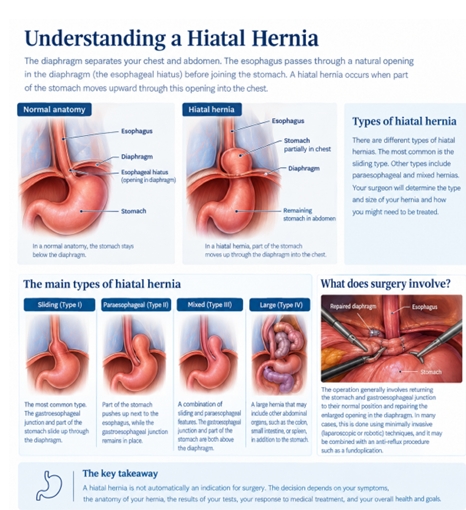
The diaphragm is the large muscle that separates the chest from the abdomen. The esophagus passes
through a natural opening in the diaphragm, called the esophageal hiatus, before joining the stomach.
A hiatal hernia occurs when part of the stomach moves upward through this opening into the chest.
What symptoms can a hiatal hernia cause?
Some people have no symptoms at all. When symptoms are present, they may include:
• Heartburn or acid reflux
• Regurgitation of food or acid
• Difficulty or discomfort when swallowing
• Chest or upper abdominal discomfort
• Feeling unusually full after eating
• Bloating or belching
• Symptoms that become worse after meals or when lying down
• Shortness of breath or reduced ability to eat normally in some patients with large hernias
It is important to remember that not every symptom is necessarily caused by the hiatal hernia. A proper
evaluation is therefore important before deciding on treatment.
When can a hiatal hernia be treated without surgery?
If the hernia is small and symptoms are mild or well controlled, surgery may not be necessary.
Treatment may include lifestyle measures and medications that reduce stomach acid, particularly when
reflux is the main problem.
Your doctor may recommend measures such as avoiding meals shortly before going to bed, identifying
foods that trigger symptoms, maintaining a healthy weight, and elevating the head of the bed when
appropriate.
However, medications can control acid production and reflux symptoms; they do not repair the anatomical
hernia itself.
When is surgery considered?
1. Persistent troublesome reflux
If you continue to experience significant reflux or regurgitation despite appropriate medical treatment,
surgical treatment may be an option in carefully selected patients. Before surgery, it is important to
confirm that the symptoms are actually related to gastroesophageal reflux and that surgery is likely to
help.
2. A large hiatal hernia
Large hiatal hernias can produce symptoms related not only to reflux but also to the abnormal position of
the stomach within the chest. The presence of a large hernia does not automatically mean that surgery is
required. The decision depends on the anatomy, symptoms, complications, and the individual patient's
circumstances.
3. Difficulty swallowing or other mechanical symptoms
A large or anatomically significant hernia can sometimes interfere with normal passage of food or alter the
function of the gastroesophageal junction. When mechanical symptoms are significant, surgical repair may
be appropriate.
4. Complications of the hernia
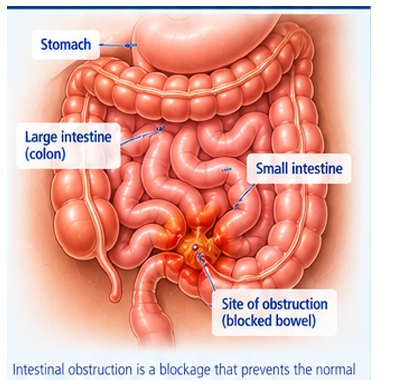
Certain complications can make surgical treatment more important. These may include obstruction,
bleeding, ulceration, significant inflammation, or problems caused by part of the stomach becoming
trapped or twisted. These situations require individualized assessment and, in some cases, urgent
treatment.
What tests are needed before surgery?
The investigations depend on your symptoms and the type of hernia, but evaluation may include:
• Upper endoscopy (gastroscopy): to examine the esophagus and stomach and look for inflammation,
ulcers, narrowing, or other abnormalities.
• Barium swallow or upper GI contrast study: particularly useful for defining the anatomy and size of a
hiatal hernia.
• Esophageal manometry: measures the function of the esophageal muscles and helps guide the choice of
surgical procedure in appropriate patients.
• Reflux testing: such as ambulatory pH or impedance monitoring, when it is necessary to objectively
confirm reflux.
Not every patient requires every test. The appropriate evaluation depends on the clinical situation.
What does hiatal hernia surgery involve?
The operation generally involves returning the stomach and gastroesophageal junction to their normal
position in the abdomen and repairing the enlarged opening in the diaphragm.
In many patients, this is performed using minimally invasive laparoscopic or robotic techniques.
The exact operation varies from patient to patient. When reflux is an important part of the problem, the
repair may be combined with an anti-reflux procedure, such as a fundoplication.
The goal is not simply to make the hernia smaller. The operation aims to restore the anatomy and create a
durable repair while preserving normal swallowing and gastric function.
What happens after surgery?
Recovery varies depending on the complexity of the operation and the individual patient.
It is common to have some temporary difficulty swallowing, bloating, or changes in eating patterns during
the early recovery period. Your surgical team will usually provide specific dietary instructions and gradually
advance your diet as healing progresses.
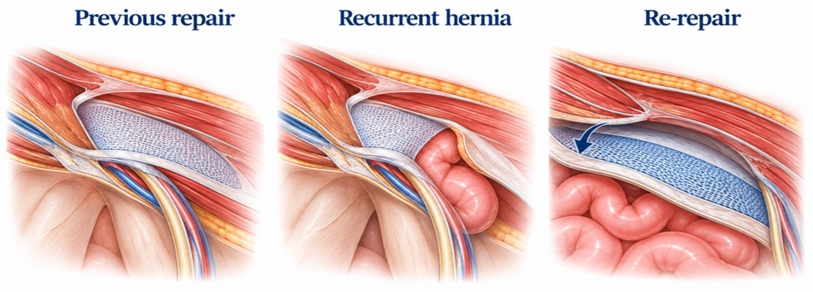
Most patients gradually return to their normal activities, but recovery after a complex or recurrent hiatal
hernia repair may take longer.
Can a hiatal hernia come back after surgery?
Like any hernia repair, hiatal hernia surgery carries a possibility of recurrence.
The risk varies substantially between patients and depends on factors such as the size and type of hernia,
the quality of the tissues, previous operations, patient-related factors, and the complexity of the repair.
Importantly, an abnormality seen on a postoperative scan does not necessarily mean that a patient needs
another operation. Recurrence should be interpreted together with the patient's symptoms and clinical
findings.
So, do you need surgery?
Not necessarily. A hiatal hernia is not, by itself, an automatic indication for surgery. Some patients can be
managed successfully without an operation, while others may benefit considerably from surgical repair.
The most important question is not simply “How big is my hernia?” but rather:
“Is my hiatal hernia causing significant problems, and is surgery likely to improve those problems safely
and durably?”
Answering that question requires an individualized assessment of your symptoms, anatomy, investigations,
general health, and treatment goals.
Frequently Asked Questions
Can a small hiatal hernia require surgery?
Yes, occasionally. Size alone does not determine whether surgery is appropriate. Symptoms, reflux,
anatomy, and other clinical factors are important.
Can a large hiatal hernia be left untreated?
Sometimes. A large hernia does not automatically require surgery, particularly if the patient has few or no
symptoms. The decision should be individualized.
Will surgery permanently cure my reflux?
Surgery can provide significant and durable improvement in appropriately selected patients, but no
operation can guarantee that reflux symptoms will never return. Proper evaluation before surgery is
therefore important.
Will I be able to eat normally after surgery?
Most patients return to a normal diet as healing progresses. Temporary swallowing difficulty and dietary
restrictions are common during the early postoperative period.
Can a hiatal hernia recur after surgery?
Yes. Recurrence is a recognized possibility. Whether a recurrence requires treatment depends on its
significance and whether it is causing symptoms or complications.
Is hiatal hernia surgery performed through large incisions?
Most elective hiatal hernia repairs today can be performed through minimally invasive laparoscopic or
robotic approaches, although the appropriate approach depends on the individual patient and the
complexity of the operation.
This fact sheet is for general educational purposes and does not replace an individualized consultation with a qualified
physician.
Dr. Mohammed Alassaf
Consultant Bariatric & Gastrointestinal Surgeon
Dr. Alassaf is a leading expert in minimally invasive and bariatric surgery,
with extensive experience helping patients overcome obesity and related conditions.
Having completed advanced training in Australia and the Middle East, he is known
for his compassionate approach and evidence-based surgical care.