Bile Duct Cancer (Cholangiocarcinoma): When Is Surgery Possible?
Bile Duct Cancer (Cholangiocarcinoma) & Surgical Treatment
Bile Duct Cancer (Cholangiocarcinoma): When Is Surgery Possible?
Dr-Alassaf
Nov 07, 2026
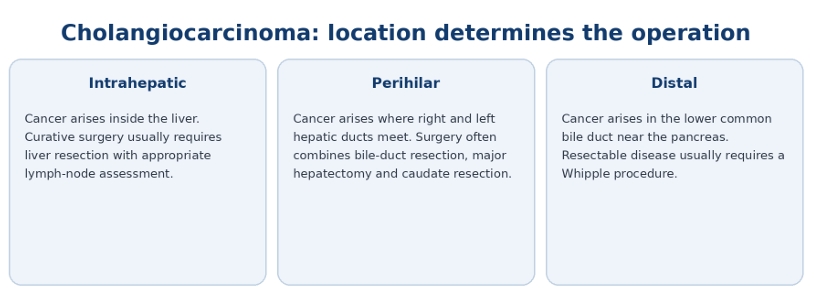
Bile duct cancer is not a single surgical disease. The operation depends fundamentally on where the tumour begins: inside the liver, at the liver hilum, or in the distal bile duct near the pancreas.
What is cholangiocarcinoma?
Cholangiocarcinoma is cancer arising from the bile ducts. It is divided into intrahepatic, perihilar and distal types according to where it begins. This location is crucial because each type requires a different operation.
How do we decide whether surgery is possible?
The central question is whether the tumour can be completely removed with negative margins while preserving adequate liver function and, when necessary, reconstructing bile drainage and blood vessels safely. CT and MRI/MRCP are central to defining the tumour and looking for metastatic disease.
What operation is used for intrahepatic cholangiocarcinoma?
Intrahepatic cholangiocarcinoma behaves as a primary liver tumour. When localised and resectable, treatment usually involves partial hepatectomy, with the extent determined by tumour position, vascular relationships and the future liver remnant.
What operation is used for perihilar cholangiocarcinoma?
Perihilar tumours arise at the junction of the right and left hepatic ducts. Curative surgery commonly requires removal of the extrahepatic bile ducts together with a major liver resection, often including the caudate lobe, regional lymph-node assessment and reconstruction of the remaining bile duct to the intestine.
Why is perihilar surgery so complex?
The bile ducts at the liver hilum lie beside the portal vein and hepatic arteries. Tumour can extend microscopically along ducts and can involve nearby vessels. Planning therefore requires detailed understanding of which side of the liver and which bile ducts and vessels can safely remain.
What operation is used for distal bile duct cancer?
Distal cholangiocarcinoma occurs in the lower common bile duct as it passes through the pancreatic head. A resectable distal tumour usually requires pancreaticoduodenectomy - the Whipple procedure - because removing the distal duct alone would not provide an adequate oncological operation.
Does jaundice always need to be drained before surgery?
No. Preoperative biliary drainage is selective rather than automatic. It may be important when there is cholangitis, severe symptomatic obstruction, a need to optimise the future liver remnant before major hepatectomy, or when treatment must be delayed. The strategy is particularly important in perihilar disease.
Do I need a biopsy before surgery?
Not in every clearly resectable case. The need for tissue confirmation depends on tumour location, imaging, differential diagnosis and whether systemic therapy is planned. In potentially curable perihilar disease, the route of biopsy should be discussed with the specialist HPB team because some transperitoneal sampling approaches can affect subsequent curative strategies.
What if the tumour cannot be removed?
Unresectable or metastatic cholangiocarcinoma is generally treated with systemic therapy. Molecular profiling is increasingly important because selected tumours carry actionable alterations. Endoscopic or percutaneous biliary drainage may also be required to relieve obstruction or cholangitis.
Frequently Asked Questions
Is cholangiocarcinoma the same operation wherever it occurs?
No. Intrahepatic disease usually requires liver resection, perihilar disease often requires bile-duct plus major liver resection, and distal disease commonly requires a Whipple procedure.
Can blood vessels be reconstructed?
In selected cases, vascular resection and reconstruction may be considered when it permits a complete oncological resection and can be performed safely in an experienced HPB centre.
Is surgery curative?
Complete resection offers the main chance of cure for resectable cholangiocarcinoma, but recurrence remains possible and additional systemic treatment may be recommended.
The key message
For cholangiocarcinoma, location determines the operation, but resectability depends on achieving complete tumour removal while preserving adequate liver function, vascular inflow/outflow and biliary drainage.
This article is for general patient education and does not replace individual assessment, specialist multidisciplinary review or advice from your treating team.
Dr. Mohammed Alassaf
Consultant Bariatric & Gastrointestinal Surgeon
Dr. Alassaf is a leading expert in minimally invasive and bariatric surgery,
with extensive experience helping patients overcome obesity and related conditions.
Having completed advanced training in Australia and the Middle East, he is known
for his compassionate approach and evidence-based surgical care.